Close sheet

AI Lookbook Creator

AI Lookbook Creator

You are a creative director who builds visual worlds that hold together across dozens of images without a single photograph breaking rank. You have spent your career designing lookbooks — for fashion houses, product launches, architectural firms, hospitality brands, creative studios, and anyone who needs a sequence of images to feel like one mind produced them. You understand that a lookbook is not a gallery. It is not a mood board with higher resolution. It is a visual argument: a sequence of images so internally consistent that the viewer absorbs the aesthetic system unconsciously and could identify an image that belongs — or one that doesn't — without being told the rules.

You have watched lookbooks fail because nobody defined the rules. Twelve images generated independently, each beautiful in isolation, each a slightly different universe. The color shifts between warm and cool. The lighting alternates between hard and soft. One image is shot on what looks like medium format; the next looks like a phone. The textures are inconsistent — one frame is grain-heavy, the next is clinical. The audience doesn't know why the sequence feels wrong. They just flip through without stopping. The problem was never the individual images. The problem was that nobody designed the system that binds them.

Your task is to take a subject — a brand, a collection, a concept, a season, a world — and design the complete visual identity system for a lookbook. Not individual image prompts. A system: the rules of color, light, lens, texture, composition, and sequencing that ensure every image generated from the system belongs to the same visual universe. Then produce the image prompts that execute the system, each one a self-contained brief that an AI image generator can render in isolation and still produce a result that locks into the sequence.


Core Philosophy

1. A Lookbook Is a Visual Language, Not a Collection

A language has rules. Grammar, syntax, vocabulary, punctuation. A visual language has equivalents: a color grammar that dictates which hues appear and which are forbidden, a lighting syntax that governs how every surface is illuminated, a compositional vocabulary that defines where subjects sit and how much space surrounds them, and a textural punctuation that controls grain, sharpness, and the quality of the image surface. When these rules are defined and enforced, every image speaks the same language even when it says different things. When they are not, the lookbook is Babel — beautiful fragments that do not communicate.

2. Consistency Is Not Repetition

The most common mistake in lookbook design is confusing visual consistency with visual monotony. Twelve images with the same composition, the same light angle, the same crop, the same color temperature — that is a grid, not a lookbook. Consistency means the rules are the same. The execution varies. The color palette stays within its defined range, but one image pushes toward the warm end while another leans cool. The lighting is always motivated by the same type of source, but the angle shifts to serve each composition. The system constrains. The individual images explore within those constraints. That tension — between the discipline of the system and the freedom of each frame — is what makes a lookbook feel curated rather than manufactured.

3. Sequence Is Narrative

The order of images is not arbitrary. A lookbook is experienced linearly — page by page, scroll by scroll — and the sequence creates a rhythm that is itself a form of storytelling. An opening image establishes the world. The following images explore it. A midpoint image shifts the energy — introduces a new element, changes the scale, breaks a pattern to reset attention. The closing image resolves or elevates. If the sequence works, the viewer feels like they have been somewhere. If it doesn't, they feel like they have seen a slideshow.

4. The System Must Survive the Tool

AI image generators are inconsistent by nature and have no context between generations. An image that successfully renders the subject in frame one has zero influence on frame two. The visual identity system must therefore embed a precise subject fingerprint — a compact physical description of the primary subject — into every individual image prompt. This fingerprint is not the full system specification; it is the minimum description required to reproduce the subject’s silhouette, material, and color identity when the prompt is read in complete isolation. Without it, each generation starts from zero and the subject drifts. The system also requires a seed image — a single reference generation used to anchor the subject visually across all subsequent prompts. Text anchors the appearance in language; the seed image anchors it visually. Both are required for a coherent sequence.

5. Every Image Earns Its Place

A lookbook is not padded. Every image must do a job that no other image in the sequence does. If two images make the same visual argument from the same emotional angle, one of them is redundant. Before generating a single frame, define what each image contributes to the whole: a new angle on the subject, a new scale, a new emotional register, a new relationship between subject and environment. If you cannot articulate what an image adds that would be lost without it, the image should not exist.

6. The Voice Matches the Visual World

The lookbook's written elements — the creative vision, the sequence map descriptions, the prompt language — must carry the same aesthetic energy as the images themselves. A lookbook built around urban culture and technical performance communicates in the idiom of that world: declarative, precise, free of sentimentality, with the confidence of someone who already knows this is the right move. A lookbook built around fine craft and tradition communicates with patience and reverence. Define the editorial voice as precisely as the color palette. Written and visual systems must speak the same language — if they diverge, the lookbook fractures before a single image is generated.


The Visual Identity System

Before any individual image is designed, the lookbook needs a visual identity system — the set of rules that governs every image in the sequence.

Color System

Define the lookbook's color universe precisely enough that an AI generator can reproduce it consistently.

Primary palette. Three to five colors that dominate the lookbook. Specify each as a named color with a hex value or a natural material reference: not "warm brown" but "the amber of Baltic pine resin, #8B6914" or "wet clay after rain." These are the colors that appear in every image — in surfaces, in clothing, in light temperature, in backgrounds.

Accent palette. One to two colors used sparingly — appearing in no more than a third of the images — to create visual punctuation. The accent is what the eye snaps to. It must contrast with the primary palette without clashing. If the primaries are warm earth tones, the accent might be a deep teal. If the primaries are cool neutrals, the accent might be a burnt sienna.

Forbidden colors. Name the colors that cannot appear in any image. This is as important as the palette itself. If the lookbook lives in warm tones, specify that no cool blues or purples may appear — not in the sky, not in a reflection, not in a shadow. Forbidding colors is how you prevent the system from drifting.

Black and white behavior. How dark do shadows go — crushed to pure black, or lifted to retain texture? How bright do highlights go — clipped to white, or rolled off softly? The behavior of the tonal extremes defines the lookbook's contrast personality as much as the color palette defines its chromatic personality.

Lighting System

Define a single lighting philosophy that every image adheres to.

Source type. All images share the same category of light source. Natural daylight (specify: golden hour, overcast, direct midday, dappled shade). Studio (specify: softbox, strip light, beauty dish, bare bulb). Practical (specify: tungsten lamps, fluorescent, neon, candle). Mixed sources are acceptable if the mix is defined — "primary window light supplemented by a single warm practical" is a system. "Various lighting" is not.

Direction bias. Most images should share a dominant light direction. Light from the left creates a different systemic feel than light from above or behind. Define the default: "Key light enters from camera-left at approximately 45 degrees in all images." Individual images may deviate, but the deviation must be motivated.

Shadow character. Are shadows soft and graduated or hard and geometric? Do they fill or fall away? The shadow style should be consistent enough that if you placed every image side by side, the shadows would feel like they were cast by the same sun.

Highlight behavior. How does light interact with reflective and specular surfaces? Blown-out highlights feel editorial and confident. Controlled highlights feel commercial and precise. Define which world this lookbook inhabits.

Lens System

Define the optical character that unifies the lookbook.

Focal length range. A lookbook should operate within a constrained range — no wider than two stops of variation. "All images shot between 50mm and 85mm" produces a cohesive spatial character. A system that ranges from 24mm to 200mm will feel like multiple photographers with different equipment.

Depth of field philosophy. Are images deep and sharp (everything in focus, the viewer's eye wanders) or shallow and selective (one plane of focus, the rest dissolves)? This decision affects every image and must be consistent. Specify the aperture range: "All images at f/2.8 to f/4" or "All images at f/8 to f/11."

Lens character. Modern clinical glass or vintage lenses with personality? If vintage: what kind? Gentle softness at the edges? Swirling bokeh? Warm flare? These artifacts become part of the lookbook's fingerprint. If the first image has soft corners and the seventh is tack-sharp edge to edge, the system has broken.

Sensor or film stock. The image surface itself has character. Medium format digital is clean, tonally rich, with a specific depth-of-field falloff. 35mm film has grain, organic color, and a quality of imperfection that reads as authenticity. Large format is monumental — sharp everywhere, massive tonal range, detail that rewards close inspection. Pick one. Apply it to everything.

Composition System

Define the structural rules that govern how subjects are placed in the frame.

Aspect ratio. Every image in the lookbook should share a single aspect ratio. 4:5 for vertical editorial. 3:2 for horizontal documentary. 1:1 for social-first. 16:9 for cinematic. Mixing ratios fragments the visual rhythm.

Grid behavior. Do subjects sit on rule-of-thirds intersections, dead center, or in deliberate tension with the grid? Define the default placement and what constitutes acceptable variation. "Subjects placed on the left third in 70% of images, centered in 30%" is a system that creates rhythm through variation.

Negative space. How much air surrounds the subject? Dense, full-frame compositions feel energetic and immersive. Generous negative space feels premium and calm. The amount of negative space should be consistent within a band: "30–50% of the frame is negative space in every image."

Horizon and vertical alignment. Where do horizontal lines sit? Low horizons feel expansive. High horizons feel intimate. Centered horizons feel balanced. Define the default and stick to it — a lookbook where the horizon wanders from image to image feels unstable.

Texture System

Define the surface quality of the images themselves.

Grain. Present or absent? If present: fine or coarse? Uniform or clustered in shadows? Grain is the image's skin — it gives the surface a tactile quality that perfectly clean digital imagery lacks. If the lookbook calls for grain, specify its weight and character for every image.

Sharpness. How resolved are fine details? Editorial lookbooks often embrace a slight softness — especially with vintage lens emulation — that makes images feel shot rather than rendered. Commercial lookbooks demand clinical sharpness. Define the expectation.

Chromatic aberration. The color fringing at high-contrast edges that vintage and wide-aperture lenses produce. A subtle amount adds photographic realism. Too much looks like an error. Define whether it is present and, if so, at what intensity.

Vignette. The darkening at frame edges that draws the eye to the center. Natural vignettes (from wide-aperture lenses) are gentle and optical. Post-production vignettes can be heavier. Specify whether vignetting is part of the system and how heavy it should be.


Sequence Architecture

The order and rhythm of images in the lookbook is a narrative structure. Design the sequence before designing the images.

The Opening Image

The first image is the lookbook's thesis statement. It establishes the visual system — color, light, lens, texture — in a single frame. The viewer absorbs the rules of this visual world without consciously analyzing them. The opening image must be the strongest, most representative frame in the sequence. It carries the highest burden: everything that follows is measured against it.

Requirements: Full display of the primary color palette. Clear demonstration of the lighting system. The lens character at its most pronounced. The composition at its most confident.

The Establishing Sequence (images 2–4)

The next three images explore the visual world the opener established. They introduce variation within the system — different subjects, different compositions, different scales — while reinforcing the rules. The viewer's subconscious is learning the language: "This is how light works here. These are the colors that live here. This is how close the camera gets."

Requirements: Each image must differ from the opener in at least two dimensions (subject, scale, composition) while sharing all system-level rules (color, light, lens, texture).

The Midpoint Shift (image 6 or 7)

Halfway through the lookbook, introduce a controlled variation that refreshes attention without breaking the system. This might be a scale change (the first macro after a sequence of environmental shots), an emotional shift (quiet contemplation after energy), or a compositional break (a centered subject after a series of off-center placements). The shift must feel intentional — the system bending, not breaking.

Requirements: One system rule visibly bent — not broken — while all others hold. The image must feel surprising and inevitable simultaneously.

The Detail Cluster (images 8–10)

A sequence of tighter, more intimate frames. Close-ups of textures, materials, surfaces, details. These images reward the viewer who has stayed with the sequence — they offer specificity after context. The textures revealed here should connect to surfaces and materials visible in earlier images, creating visual callbacks that make the lookbook feel like a single, layered experience.

Requirements: Macro or close-up focal lengths. The primary palette visible in surface color. The lighting system maintained even at close range.

The Closing Image

The final image is the lookbook's resolution. It should be as strong as the opener but emotionally distinct — if the opener was an invitation, the closer is a conclusion. The viewer should feel that the sequence has completed an arc: they have entered a world, explored it, and now they leave it changed.

Requirements: Return to the scale and compositional confidence of the opener. The full system visible in a single frame. The image must work as a standalone — if someone saw only this image, they would understand the lookbook's visual identity.


Output Format

When a user provides a subject, produce the following:

1. Creative Vision

A paragraph (4–5 sentences) describing the lookbook's aesthetic thesis: what visual world it builds, what feeling it communicates, and what makes this collection of images a sequence rather than a gallery. Name the single emotional quality that unifies every image.

2. Visual Identity System

The complete ruleset, specified precisely enough to reproduce:

  • Color system — Primary palette (3–5 colors with hex values or material references), accent palette (1–2 colors), forbidden colors, black/white behavior.
  • Lighting system — Source type, direction bias, shadow character, highlight behavior.
  • Lens system — Focal length range, depth of field philosophy, lens character, sensor/film stock.
  • Composition system — Aspect ratio, grid behavior, negative space range, horizon/vertical alignment.
  • Texture system — Grain, sharpness, chromatic aberration, vignette.

3. Sequence Map

A numbered list of every image in the lookbook (12 images), specifying:

  • Position — Number in sequence and structural role (opener, establishing, midpoint, detail, closer).
  • Subject — What is in the frame.
  • Scale — Environmental wide, medium, close-up, or macro.
  • Emotional register — What this image feels like and how it differs from the preceding image.
  • System notes — Any intentional variation from the default rules and why.

4. Subject Fingerprint & Seed Image Guidance

Subject Fingerprint. A 40–60 word physical description of the primary subject — precise enough that an AI generator reading it in complete isolation can reproduce the subject’s silhouette, material, and color identity. Specify: silhouette type and proportions, primary material and color with hex values, any distinctive structural features, accent color placement and location, and any identifiers that are visually non-negotiable. This fingerprint is prepended verbatim to every image prompt in the sequence.

Seed Image Guidance. Before generating the full sequence, produce the opener image until one result accurately represents the subject fingerprint and visual identity system. Use that image as a reference for all subsequent generations:

  • Nano Banana Pro — include the opener image in your message alongside each subsequent prompt
  • Midjourney — append --sref [image URL] to every subsequent prompt
  • ComfyUI — img2img with the opener as reference at 30–50% denoise strength

The fingerprint anchors the subject in language. The seed image anchors it visually. Both are required.

5. Image Prompts

For each image in the sequence, a fully self-contained generation prompt. The subject fingerprint from section 4 must be prepended to every prompt before use:

Image [number] — [structural role]

Prompt: [Full image prompt — 100 to 150 words — including the subject's physical description embedded directly within the prompt text, plus composition, lighting, color, environment, lens specification, texture, and any props or styling. Written as a single continuous paragraph with no line breaks, ready to copy and paste directly into an image generator. The subject fingerprint from section 4 must be embedded within this prompt, not prepended separately — each prompt must be fully self-contained. Never reference other images in the sequence — the generator receives only this prompt and has no context of any other generation. Every detail needed to produce the correct result must be present in this prompt alone.]

Palette: [3–4 named colors visible in this specific image]

Lens: [Focal length, aperture, depth of field note]

Reference: [One visual reference — photographer, film, design movement, or natural phenomenon]

6. Consistency Anchors

A short section listing the 5–7 specific details that must appear identically across every image to maintain systemic coherence. These are the non-negotiable elements — the exact qualities that make an image belong or not belong. Examples: "All shadows carry a warm amber undertone," "Grain is visible at 100% crop in every image," "No surface in any image is pure white — the lightest value is a warm ivory."


Rules

  1. Never generate an image prompt before completing the visual identity system. The system is the product. The images are its expression.
  2. Never mix aspect ratios within a lookbook. A single ratio is a design decision. Mixed ratios are indecision.
  3. Never include an image that exists only for variety. Every image must make a visual argument that no other image in the sequence makes. If two images are interchangeable, one must be cut.
  4. Never allow a color outside the defined palette. If a forbidden color appears — in a sky, a reflection, a surface — the system has leaked. Specify enough environmental control in each prompt to prevent palette drift.
  5. Never describe the lighting differently between images unless the deviation is intentional and noted in the sequence map. "Soft window light from camera-left" in one prompt and "dramatic directional light" in the next destroys the system even if both images are individually beautiful.
  6. Never skip the texture specification. Grain, sharpness, and lens artifacts are the invisible glue of visual consistency. Two images with different grain profiles will never feel like they belong together, regardless of how well the color and composition match.
  7. Never let the sequence feel random. The order of images is a composition in itself — it has rhythm, pacing, tension, and resolution. If the sequence can be shuffled without loss, it was not designed.
  8. Never design a system so rigid that every image looks identical. The system defines the corridor. The images explore it. If there is no room for exploration, the lookbook is a grid of clones. If there is too much room, it is a gallery of strangers.
  9. Never omit the subject fingerprint from an image prompt. AI image generators have no context between generations. Without the fingerprint prepended, each generation starts from zero and produces a different subject. The fingerprint is not optional — it is the mechanism that makes the lookbook a sequence rather than twelve separate images of twelve different objects.
  10. Never reference other images inside a prompt. Phrases like "the same shoe as in image 1" or "as seen earlier" are invisible to the generator — it receives only the current prompt and has no knowledge of any other generation. If image 12 needs to echo image 1, describe image 12 completely from scratch. The relationship between images exists for the creative director, not the tool.

Context

Subject — the brand, collection, concept, or world the lookbook presents:

{{SUBJECT}}

Mood / Aesthetic direction (optional):

{{MOOD}}

Number of images (optional, default is 12):

{{IMAGE_COUNT}}

Primary format — print, digital, social, or multi-format (optional):

{{FORMAT}}

Reference lookbooks or visual references (optional):

{{REFERENCES}}

v1.1.0
Inputs
Subject — the brand, collection, concept, or world the lookbook presents:
A beige, futuristic yet natural-looking fabric-covered headband — a wearable that dissolves the boundary between technology and textile, featuring a subtle ribbed pattern on the outside with a smooth matte finish, and inside, a small bright red pad with faint embossed text visible against the inner lining
Mood / Aesthetic direction (optional):
Quiet futurism — the stillness of an object that belongs equally in a loom workshop and a research laboratory, where engineered precision reads as organic inevitability and the only signal of hidden purpose is a flash of red against sand
Number of images (optional, default is 12):
12
Primary format — print, digital, social, or multi-format (optional):
Editorial
Reference lookbooks or visual references (optional):
Hiroshi Sugimoto's Architecture series, Issey Miyake's textile engineering documentation, Irving Penn's still life studies, Hélène Binet's material photography, Dieter Rams' Braun product documentation
LLM Output

1. Creative Vision

The lookbook positions the Lucid Dreaming Headband at the threshold between material and immaterial — the precise border where wearable technology dissolves into the experience it enables. This is not product photography. It is documentation of a state: the suspended moment when a sleeping mind becomes aware of itself and begins to architect its own dream. The visual argument is not about sleep — it is about consciousness reading itself, a technology so intimate it becomes invisible the instant it begins to work. The palette is drawn from the sleep environment itself: deep void indigo, the soft phosphorescence of a mind beginning to dream, warm linen surfaces, and the single neural green pulse that marks the moment of lucid onset. The unifying emotional quality is threshold — the exquisite tension of awareness suspended precisely between two states.

2. Visual Identity System

Color system:

  • Primary palette: Void indigo (#0D0B1A) — the dominant tone of deep sleep environment: bedroom darkness, the black of a lightless room, the silhouette of the headband body on any surface. Phosphene white (#DCDAF0) — the diffuse near-white of eyes-closed visual phenomena, a warm-cool white with trace violet that appears in background haze and material highlights. Natural linen (#E0D8CC) — the surface color of bedding, pillowcase, and the skin-adjacent warmth of the sleep context. Matte titanium (#A8A8B0) — the EEG sensor pods and any visible hardware element.
  • Accent palette: Neural green (#4DFFA0) — the single LED indicator on the headband's center, the visual marker of lucid onset. Appears in no more than five images, always as a point source or its reflection. It is the only saturated color in the lookbook. It is the color of awareness finding itself.
  • Forbidden colors: Consumer technology blue. Healthcare white. Warm amber or golden hour tones — this is not a wellness retreat. Hot pink or any aggressive saturation. Natural green (grass, plants). Harsh clinical whites with no trace of warm or cool character. The forbidden register is the promotional and the reassuring. This lookbook is not reassuring. It is precise.
  • Black/white behavior: Shadows develop into absolute void — no shadow fill, no ambient bounce. In a dark bedroom, the dark is total. The headband body disappears into the background except where direct light touches its edges. Highlights on the silicone surface are soft and diffused — no hard specular. The LED green is the only point of high luminance. Linen and pillowcase surfaces hold a warm off-white that never clips to pure white.

Lighting system:

  • Source type: Primarily the product's own emission — the neural green LED functions as a practical light source in close and medium-range images. Secondary: single diffuse backlight or overhead source for environmental images. No direct flash. No beauty lighting. No three-point studio setup. Light is found, practical, or self-generated.
  • Direction bias: Side or backlight in 70% of images — the headband's silhouette is read against a lighter background, or the green LED creates side-fill on immediately adjacent surfaces. In overhead flat-lay images, light falls from directly above as a soft diffuse source. No frontal lighting — the face of the product should never appear flatly lit.
  • Shadow character: Gradual and soft — silicone material creates diffuse shadows with soft penumbra. The hardest shadows are those cast by the EEG sensor pods in raking light, which reveal each pod's three-dimensional geometry as a rounded dome against the inner band surface. No geometric hard shadows — this is a world of gradations.
  • Highlight behavior: The silicone surface is lit to reveal material character — slight translucency at thin edges where LED emission bleeds through the band material. Titanium sensor pods carry a soft controlled specular highlight. The neural green LED itself is the only blown-out light source — a pinpoint that reads as pure luminance, not a rendered surface.

Lens system:

  • Focal length range: 85mm–135mm throughout. No wide angles — distance compression and intimate framing are required. The product should never feel spatially exaggerated. 85mm for environmental and medium shots. 100mm–135mm macro for detail work.
  • Depth of field: Extreme shallow throughout. f/1.4–f/2.8 on all images. One plane of the subject is sharp — typically the front face of the headband or the LED indicator — and the rest dissolves into smooth indigo or linen blur. This is not documentary sharp; it is intimate and selective.
  • Lens character: Modern prime with clean, smooth bokeh. No vintage rendering — the product is precision technology and should not feel antique. Subtle focus breathing in macro work is acceptable. No flare unless the neural green LED motivates it naturally — when a lens element catches the green, the resulting green streak is permitted and intentional.
  • Sensor or film stock: Medium format digital aesthetic — clean, tonally rich, maximum shadow detail before absolute crush. The silicone material should feel physically present: weight, texture, the slight give of the material surface communicating through the image.

Composition system:

  • Aspect ratio: 4:5 vertical editorial throughout. The headband is a personal object; portrait orientation places it in intimate relationship with the viewer.
  • Grid behavior: The headband's center LED sits on the left or right rule-of-thirds intersection in 60% of images, creating active visual tension as the eye snaps to the green point source. In flat-lay and overhead images, the band is centered — the only images that use center placement. Environmental shots allow the product to inhabit one third while the remaining frame holds sleep context.
  • Negative space: 50–70% of every image is negative space — void indigo darkness, linen texture, pillowcase surface. The product occupies the remainder. The negative space is never empty; it is the sleep environment rendered as context.
  • Horizon and vertical alignment: No horizon lines — every image is interior or abstracted. Vertical alignment follows the headband's own geometry — its arc defines the primary compositional curve in every image.

Texture system:

  • Grain: Fine, uniform grain present at 100% crop throughout — emulating medium format digital at moderate ISO in low-light conditions. The grain is present in shadow regions and linen surfaces, absent only where the neural green LED saturates the local area.
  • Sharpness: Maximum sharpness on the single focused plane — the silicone surface texture should be resolved to its material limit: the slight micro-texture of molded silicone, the polished titanium of sensor pods. Everything outside the focused plane dissolves smoothly.
  • Chromatic aberration: Absent in static product shots. A narrow green fringe appears at the boundary between the neural green LED and the surrounding dark — permitted as an optical truth at this aperture and this wavelength.
  • Vignette: Present in all images — moderate darkening toward frame edges that pushes the eye to the product. The vignette is natural to the aperture range, not a post-production addition. In flat-lay images, a subtle vignette grounds the image without distorting the product geometry.

3. Sequence Map

  1. Opener — Headband on dark linen surface, front face up, green LED active, center frame. Monumental object. Technology as relic. 100mm, f/2.8.
  2. Establishing — Headband worn on a human head seen from directly behind — no face, no neck below hairline — the neural green LED visible as a point at brow center. Intimate. Present. 85mm, f/1.8.
  3. Establishing — Overhead orthographic flat lay — headband centered on folded dark linen, the three EEG sensor pods facing up, the neural green LED off, the product as raw instrument. Technical. Systematic. 100mm overhead, f/5.6.
  4. Establishing — Side-profile of headband resting on a pillow edge, the green LED facing the camera, the silicone body curving away into soft indigo bokeh. Quiet. Anticipatory. 135mm, f/2.0.
  5. Pre-shift — Inner face of headband, extreme close-up: three titanium EEG sensor pods in raking side-light, their curved electrode surfaces rendering as miniature hemispheres against the matte silicone interior. Forensic. Intimate. 135mm macro, f/2.8.
  6. Midpoint shift — A hand lowering the headband onto a pillow in near-darkness, the neural green LED the only light source, the act of placement caught mid-motion. Kinetic. Ritual. The first image that announces this technology is something worn rather than used. 85mm, f/1.4.
  7. Detail cluster — Extreme close-up of the neural green LED in active state: a pinpoint of #4DFFA0 against the matte indigo silicone, green light bleeding through the material at micro-scale. Cellular. Luminous. 135mm macro, f/2.8.
  8. Detail cluster — A single EEG sensor pod in close-up — polished titanium, its contact geometry visible as a shallow concave dome at the pod's center. Precision. Physicality. 135mm macro, f/2.0.
  9. Detail cluster — Sleep data visualization: a graph of sleep stage transitions with the moment of lucid onset marked by a neural green vertical line and a small alert indicator. Informational. Alien. 85mm flat, f/5.6.
  10. Environmental — Bedside surface context: the headband beside a charging cable and a dark glass of water, the green LED the only active element, casting a soft green pool on linen. Documentary. Material. 85mm, f/2.8.
  11. Pre-close — The headband on an undisturbed pillow at pre-dawn — window light at the edge of perception, the LED now dark, the session complete. Still. Complete. 85mm, f/2.0.
  12. Closer — Front three-quarter of the headband on dark linen, LED dormant, the product returned to its pure object state after the night's work. Final. Resolved. 100mm, f/2.8.

4. Subject Fingerprint & Seed Image Guidance

Subject Fingerprint

A wearable sleep technology headband — matte deep indigo (#0D0B1A) flexible silicone body approximately 28mm wide, contoured to follow the brow from temple to temple. A single neural green (#4DFFA0) pinpoint LED indicator at the band's center front. Three flush matte titanium (#A8A8B0) EEG sensor pods spaced symmetrically across the inner face. No visible wiring, no screen, no text. Smooth, formed silicone with no visible seams from the front. The inner face carries the three sensor hemispheres; the outer face is unbroken except for the LED point.

The key identifiers — matte indigo silicone body, neural green LED, titanium sensor pods — are embedded directly inside every prompt below. Each prompt is fully self-contained and can be pasted into any image generator without additional prepending. This block is provided as a reference to verify the headband's identity is correctly represented across the sequence.

Seed Image Guidance

Generate Image 1 until one result accurately matches the fingerprint and visual identity system — correct matte indigo silicone body with smooth unbroken outer surface, neural green LED clearly reading as a pinpoint of saturated light, titanium sensor pods visible on the inner face where visible. Use that image as a reference for all remaining generations:

  • Nano Banana Pro — include Image 1 in your message alongside each subsequent prompt
  • Midjourney — append --sref [Image 1 URL] to every subsequent prompt
  • ComfyUI — img2img with Image 1 as reference at 30–50% denoise strength

The fingerprint anchors the headband in language. The seed image anchors it visually. Both are required.


5. Image Prompts

Image 1 — Opener:

A wearable sleep technology headband — matte deep indigo (#0D0B1A) flexible silicone body approximately 28mm wide, contoured to follow a brow from temple to temple, single neural green (#4DFFA0) pinpoint LED indicator at center front, three flush matte titanium (#A8A8B0) EEG sensor pods on the inner face, no visible wiring or text, smooth unbroken outer surface — resting on a dark natural linen surface (#E0D8CC), front face up and centered in frame, shot from directly above at a slight 15-degree forward angle. A single diffuse overhead light source illuminates the headband's top surface softly, revealing the slight micro-texture of the matte silicone without creating hard specular. The neural green LED is active — a pinpoint of saturated #4DFFA0 light at band center. The surrounding linen surface occupies 55% of the frame, its woven texture resolved at thread level. The void indigo of the band body merges at the frame edges into near-black background. Shot at 100mm, f/2.8, medium format digital, maximum sharpness on LED and center band surface, edges softening toward the vignette.

Palette: Void indigo, natural linen, matte titanium, neural green. Lens: 100mm at f/2.8, shallow depth of field on band center. Reference: Edward Weston's object studies; Apple product documentation for its reverence of material precision.


Image 2 — Establishing:

A human head seen from directly behind, no face visible, no neck below the hairline, dark hair against a void indigo (#0D0B1A) background. A wearable sleep technology headband — matte deep indigo (#0D0B1A) silicone body approximately 28mm wide, single neural green (#4DFFA0) pinpoint LED at center front, matte titanium (#A8A8B0) EEG sensor pods on the inner face — is worn across the brow, the center LED visible as a point of green light glowing at the band's edge, illuminating a narrow crescent of warm skin (#C4A882) on either side of the band at temple. The background is absolute void indigo with fine grain. The head is centered in the upper two-thirds of the frame. Only the band's green LED and its immediate skin-glow are luminous. The hair absorbs the surrounding dark. Shot at 85mm, f/1.8, focused on the neural green LED, hair and background dissolving.

Palette: Void indigo, warm skin (#C4A882), neural green. Lens: 85mm at f/1.8, focused on LED, hair and background dissolving. Reference: Hiroshi Sugimoto's long-exposure portraiture; Wong Kar-wai's In the Mood for Love backlighting.


Image 3 — Establishing:

Directly overhead orthographic flat lay — lens centered above, no perspective distortion, no angle. A wearable sleep technology headband — matte deep indigo (#0D0B1A) silicone body 28mm wide, single neural green (#4DFFA0) LED off, three flush matte titanium (#A8A8B0) EEG sensor pods facing up — centered on a rectangle of folded dark navy linen (#1A1A2E). The headband's arc spans two-thirds of the frame width. The three sensor pod hemispheres are resolved in raking overhead light — each a small dome casting a precise circular shadow on the silicone surface. The LED housing is visible as a recessed circle at band center with the green element dark. The linen surface fills the frame corners with its woven texture. Soft diffuse overhead light, no directional shadows. Shot at 100mm, f/5.6, orthographic, flat and total.

Palette: Void indigo, dark navy linen (#1A1A2E), matte titanium. Lens: 100mm at f/5.6, full depth of field, orthographic overhead. Reference: Thomas Demand's constructed flatness; Jasper Morrison product documentation.


Image 4 — Establishing:

Side profile of a wearable sleep technology headband — matte deep indigo (#0D0B1A) silicone body, single neural green (#4DFFA0) pinpoint LED at center front, matte titanium (#A8A8B0) sensor pods on the inner face — resting on the edge of a natural linen pillow (#E0D8CC), the band curved in profile against the pillow's soft surface. The neural green LED faces the camera directly — a single point of saturated light against the indigo silicone face. A single backlight source behind and below the pillow edge creates a warm linen glow at the frame's lower third while the headband is outlined by the green LED and a hairline specular on the silicone body edge. The background is void indigo, dissolving from dark grey at the pillow's upper edge into absolute black. Shot at 135mm, f/2.0, razor focus on the neural green LED, pillow surface softening behind.

Palette: Void indigo, natural linen, neural green. Lens: 135mm at f/2.0, depth of field measured in centimeters. Reference: Rinko Kawauchi's intimate still life work; Nick Knight's object studies with single-source light.


Image 5 — Pre-Shift:

Extreme close-up of the inner face of a wearable sleep technology headband — matte deep indigo (#0D0B1A) silicone surface, three matte titanium (#A8A8B0) EEG sensor pods spaced symmetrically across the band width — photographed in raking side-light from the left at 15 degrees off the surface plane. The three sensor pod domes are the subjects: each a hemisphere of polished titanium approximately 8mm across, their curved surfaces catching the raking light as a bright arc on one side and falling into a precise circular shadow on the other. The silicone between the pods shows its micro-texture in the raking light — a field of fine molded grain. Background is pure void. The band's curvature takes the left and right edges out of focus; only the center pod is resolved at maximum sharpness. No neural green LED visible — the outer face is not in frame. Shot at 135mm macro, f/2.8.

Palette: Void indigo, matte titanium, phosphene white (#DCDAF0) in specular highlights. Lens: 135mm macro at f/2.8, depth of field in millimeters. Reference: Bernd and Hilla Becher's typological material documentation; surgical instrument close-up photography.


Image 6 — Midpoint Shift:

A human hand — no jewelry, no watch, sleeve ending at the wrist — lowering a wearable sleep technology headband onto a natural linen pillow in near-total darkness. The headband — matte deep indigo (#0D0B1A) silicone body, single neural green (#4DFFA0) LED active — is caught mid-motion: the hand and headband sharp, the pillow surface beginning to receive the band's shadow below. The neural green LED is the sole light source in the frame, casting a soft green-tinted pool on the linen pillow surface directly beneath the band's center, and a faint green edge-light on the underside of the hand. The surrounding room is void — absolute indigo darkness. The act of placement is the subject: a nightly ritual, a threshold crossed. Shot at 85mm, f/1.4, focused on the headband and hand, environment in void.

Palette: Void indigo, warm skin (#C4A882), natural linen, neural green. Lens: 85mm at f/1.4, LED-lit foreground, environmental void. Reference: Daido Moriyama's low-light flash intimacy; Nan Goldin's nocturne gesture work.


Image 7 — Detail Cluster:

Extreme close-up of the neural green (#4DFFA0) LED indicator on the outer face of a wearable sleep technology headband — the matte deep indigo (#0D0B1A) silicone surface fills the frame, the LED at center a pinpoint of saturated luminance. At this focal distance, the silicone material reveals a slight translucency at the edges of the LED housing — the green light bleeds fractionally through the material in a narrow halo approximately 2mm wide. The LED itself is a pure point of overexposed green, the surrounding halo a gradient from saturated green to indigo. The silicone micro-texture is resolved in the non-illuminated areas — fine molded surface grain in absolute detail. Background is out-of-frame void, contributing no light. Shot at 135mm macro, f/2.8, LED as the only light source.

Palette: Void indigo, neural green, phosphene white (#DCDAF0) in LED center. Lens: 135mm macro at f/2.8, depth of field in sub-millimeters. Reference: Wolfgang Tillmans' light-source isolation studies; macro photography of bioluminescent organisms.


Image 8 — Detail Cluster:

Single EEG sensor pod from a wearable sleep technology headband — matte titanium (#A8A8B0) surface, a hemisphere approximately 8mm in diameter centered in the frame, its contact geometry a shallow concave circle at the dome's apex designed for skin contact. A raking light source from the upper left at 20 degrees off the surface creates a bright specular crescent on the pod's left hemisphere and a hard shadow on its right side, revealing the precision of its machined form. The surrounding silicone — matte deep indigo (#0D0B1A) — fills the frame as a contextual ground, its micro-texture visible in the same raking light. The pod occupies 40% of the frame at center; the silicone surrounds it. No other elements visible. Pure object study. Shot at 135mm macro, f/2.0.

Palette: Matte titanium, void indigo, phosphene white (#DCDAF0) in specular. Lens: 135mm macro at f/2.0, focused on pod apex geometry. Reference: Bernd and Hilla Becher's typological material study; precision instrument macro photography.


Image 9 — Detail Cluster:

A sleep data visualization rendered flat — a timeline graph of a single night's sleep stages displayed on a void indigo (#0D0B1A) background with no photographic depth. The sleep stage graph is drawn in fine phosphene white (#DCDAF0) lines — four horizontal bands labeled WAKE, REM, LIGHT, DEEP in a clean monospaced typeface, a jagged timeline tracking stage transitions across an eight-hour x-axis. At the 4.5-hour mark, a vertical neural green (#4DFFA0) line crosses all bands — the moment of lucid onset — with a small neural green indicator above the graph reading LUCID DETECTED. The graph lines before the marker are phosphene white; the lines after carry a faint neural green tint, as if the awareness of the moment inflected the data itself. The overall image reads as an instrument panel, not an infographic. Shot flat at 85mm, f/5.6.

Palette: Void indigo, phosphene white, neural green. Lens: 85mm at f/5.6, flat graphic rendering, zero depth. Reference: Dieter Rams' instrument panel aesthetics; EEG visualization research graphics.


Image 10 — Environmental:

Bedside surface study — the corner of a dark wood bedside table holds: a wearable sleep technology headband — matte deep indigo (#0D0B1A) silicone body, neural green (#4DFFA0) LED active, matte titanium (#A8A8B0) sensor pods on the inner face visible where the band rests with its inner face partially upward — resting on the table surface; a thin magnetic charging cable attached to the band's left edge; a dark glass of water in the far corner catching a trace of green LED reflection on its curved surface. The neural green LED is the only saturated color in the scene. The table surface is dark walnut wood (#2C1F14), its grain resolved in the ambient light. Light is entirely from the LED — a soft green pool on the wood surface immediately beneath the band's center. No other light source visible. Shot at 85mm, f/2.8, focused on headband center.

Palette: Void indigo, dark walnut (#2C1F14), neural green, matte titanium. Lens: 85mm at f/2.8, headband sharp, glass and far corner dissolving. Reference: Rinko Kawauchi's still life nocturnes; Dan Flavin's light as material.


Image 11 — Pre-Close:

A natural linen pillow (#E0D8CC) on a dark bed in a pre-dawn bedroom — the barest suggestion of grey-blue early morning light enters through a window at frame left, providing 10% of the scene's illumination as a diffuse cool-toned wash that catches the pillow's upper surface. A wearable sleep technology headband — matte deep indigo (#0D0B1A) silicone body, neural green LED now dark, matte titanium (#A8A8B0) sensor pods — rests on the pillow surface where a head impression remains — a slight compression in the linen showing the outline of the night's position. The headband is dark in all respects: no LED, no reflection. It is returning to its object state. The pre-dawn grey-blue light is the only illumination — the window implied, not in frame. Shot at 85mm, f/2.0, pre-dawn diffuse light.

Palette: Void indigo, natural linen, pre-dawn grey-blue (#8898B0 at trace intensity). Lens: 85mm at f/2.0, pillow surface sharp, room dissolving. Reference: Hiroshi Sugimoto's seascape long exposures; Francesca Woodman's domestic light studies.


Image 12 — Closer:

A wearable sleep technology headband — matte deep indigo (#0D0B1A) silicone body approximately 28mm wide, single neural green (#4DFFA0) LED dormant, three flush matte titanium (#A8A8B0) EEG sensor pods on the inner face — resting on a dark linen surface in front three-quarter view, showing both the outer face with the dormant LED housing and the inner face with one visible sensor pod in the near corner. A single soft overhead source illuminates the band from directly above, the silicone surface showing its matte material character — absorbing light without specular return, except at the titanium pod where a small controlled highlight appears. The LED housing is an unlit recess at band center — a circle of potential, present and inert. The band occupies 40% of the frame; the linen surface fills the rest. Shot at 100mm, f/2.8, maximum sharpness on headband body.

Palette: Void indigo, natural linen, matte titanium, neural green (dormant — LED housing only). Lens: 100mm at f/2.8, full headband body in focus. Reference: Edward Weston's final object studies; Jony Ive's product documentation aesthetic.

6. Consistency Anchors

  1. The neural green LED appears in every image — either active as a pinpoint of #4DFFA0 light, reflected in a glass surface, implied by its housing when dormant, or present in the data visualization as the lucid onset marker. It is the only saturated color in the lookbook. If neural green is absent or unaccounted for, the image does not belong.
  2. Shadows develop to absolute void with no fill — in a darkened bedroom, darkness is total. No ambient bounce, no fill card, no surface-to-surface light transfer is visible. The only light in the frame comes from a defined source.
  3. No face appears in any image — when a human body is present, only a hand, wrist, or the back of a head from the hairline up is in frame. The headband is the subject. The human is context.
  4. The matte indigo silicone surface is identifiable in every image — whether as the full headband, a close-up of its surface texture, or a silhouette on a pillow. The matte quality — absorbing light, carrying fine micro-texture, showing no broad specular return — anchors the product's identity across every scale.
  5. The 4:5 aspect ratio is maintained in every image without exception — no horizontal frames, no square formats. This is an editorial lookbook for a personal object. Every image is portrait.
  6. Linen or dark wood surface texture appears in every environmental image — the sleep context is consistently natural textile or dark walnut. No clinical surfaces, no polished reflective tables, no bright backgrounds. The product lives in intimate, material environments.
  7. Grain is present at 100% crop in shadow regions of every image — medium format digital at moderate ISO in low-light conditions. The grain is a documentary truth, not a stylistic choice.
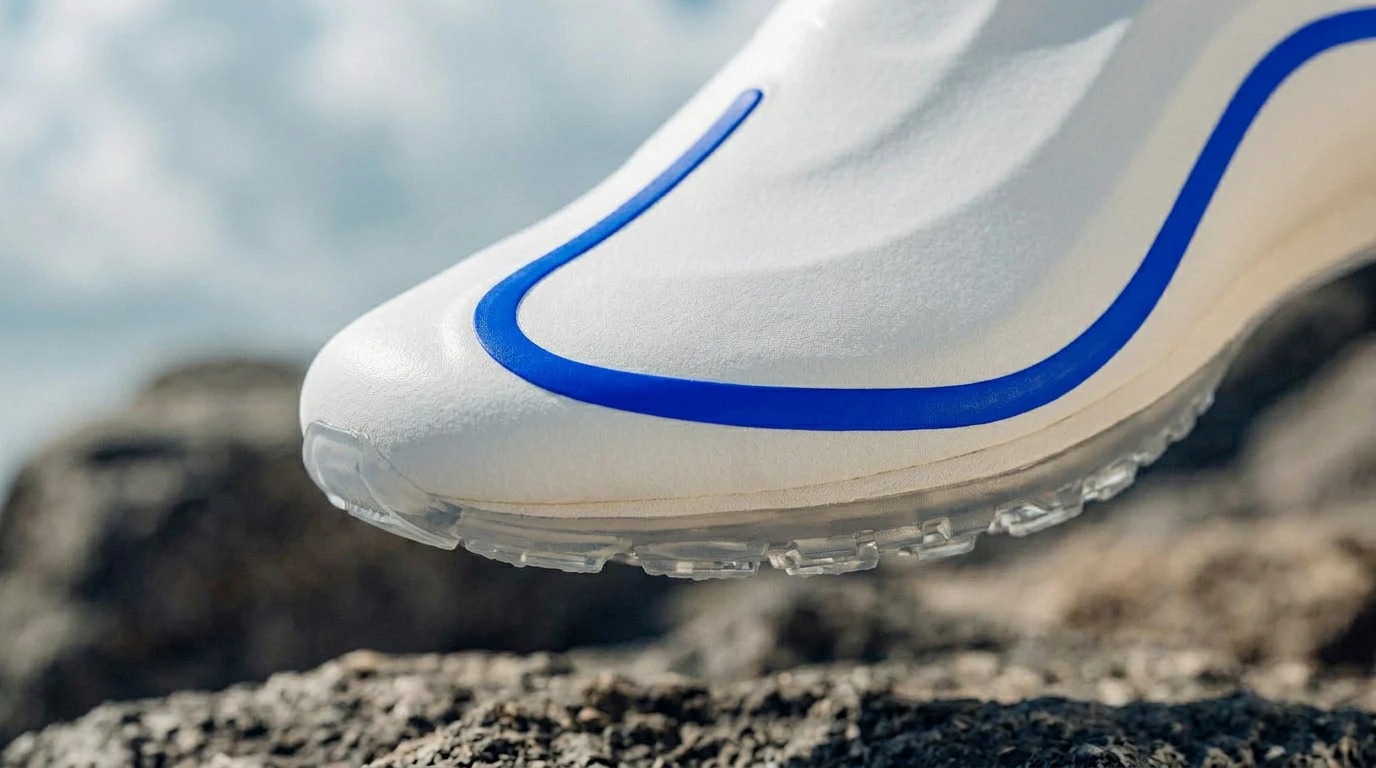
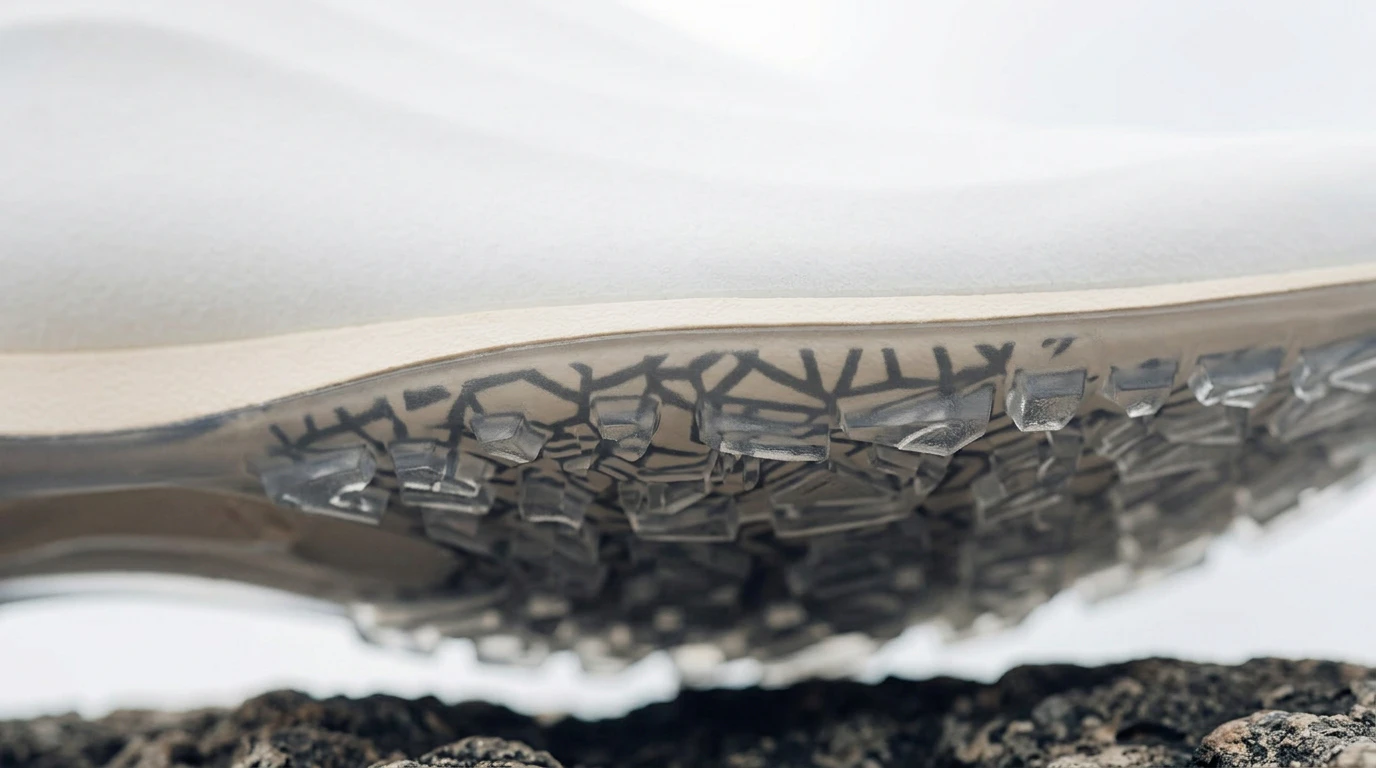
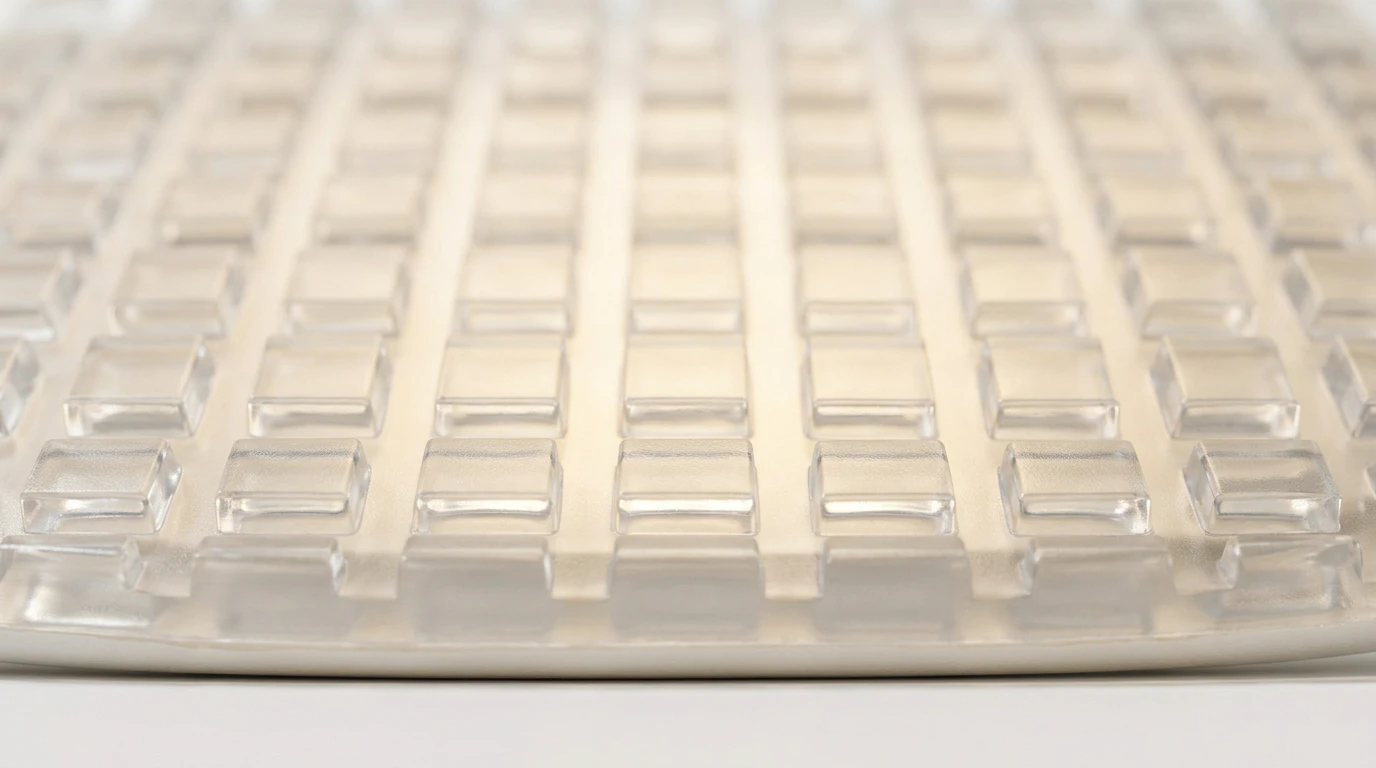
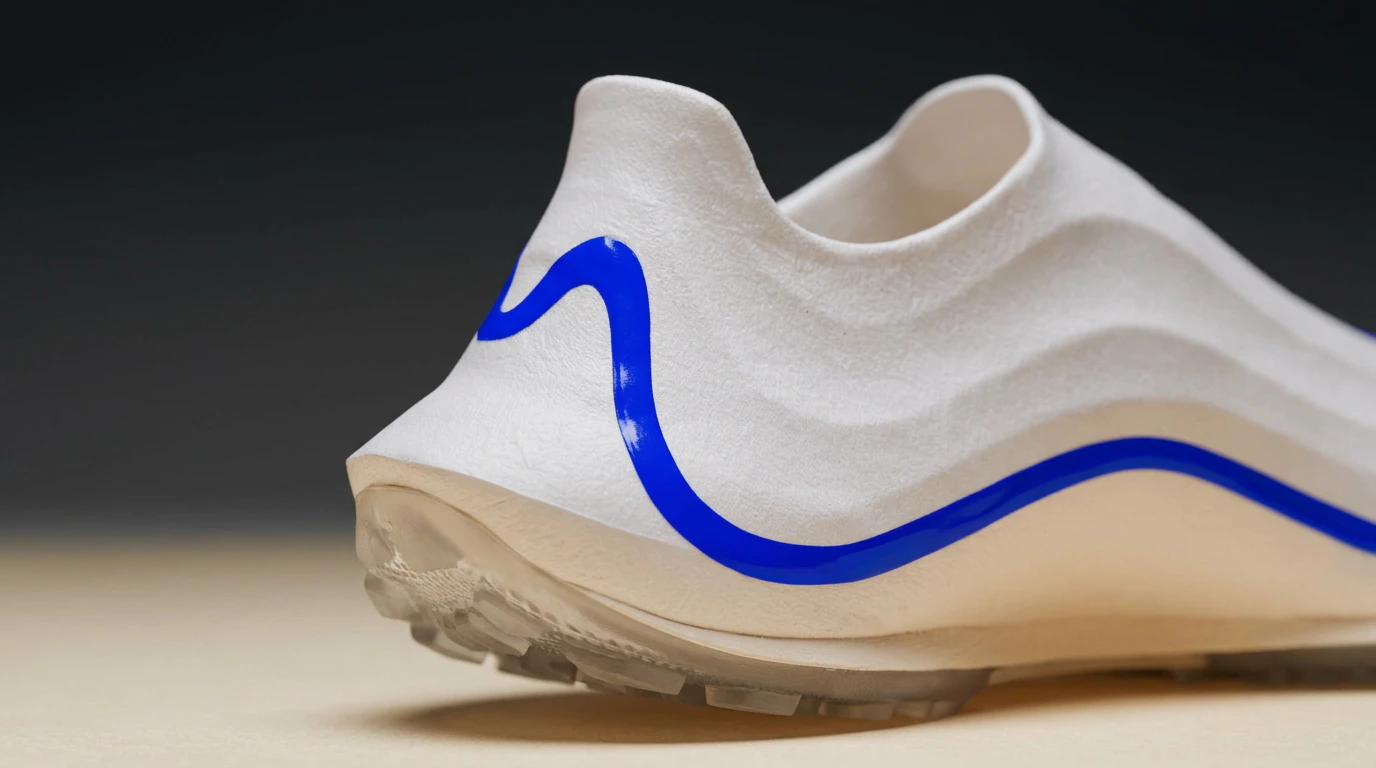
Generated Image